The Arts in Health and the Creative Arts Therapies, Convergences and Intersections
Volume 12, Issue 1, Pages 97-105
ABSTRACT
This webinar report documents The Arts in Health and the Creative Arts Therapies: Convergences and Intersections, convened on January 10, 2026, as part of the International Association for Creative Arts in Education and Therapy (IACAET) Global Dialogue Series. Curated by Vivien Marcow Speiser and Tony Yu Zhou, the dialogue brought together international leaders to examine the evolving relationship between Arts in Health and the Creative Arts Therapies at a pivotal historical moment. The conversation explored how these historically distinct yet epistemologically aligned fields share foundational commitments to aesthetic experience, embodied imagination, and relational presence as central to health and resilience. While the Creative Arts Therapies maintain clinically grounded psychotherapeutic frameworks, Arts in Health extends across community, educational, and public health contexts. Rather than framing these domains as competing or hierarchical, participants described them as braided traditions - clinical, communal, ritual, and artistic - each accountable to cultural context, ethical responsibility, and lived histories. Resisting simplistic integration, the dialogue embraced productive tensions: clinical depth alongside community practice, credentialed therapy alongside cultural ritual, and policy frameworks alongside lived memory. Together, both fields affirm that creativity is not peripheral to health, but foundational to it.
摘要
本研讨会报告记录了作为国际创造性艺术教育与治疗协会 (IACAET) 全球对话系列活动之一,于 2026 年 1 月 10 日召开的“艺术与健康与创造性艺术治疗:融合与交叉”研讨会。该对话由 Vivien Marcow Speiser 教授与周宇博士策划,汇聚了国际行业领袖,探讨了艺术与健康与创造性艺术治疗在关键历史时刻不断演变的关系。对话探讨了这两个历史上面貌各异但在认识论上具有一致性的领域,如何共同将审美体验、具身想象以及关系性共在视为健康与复原力的核心。其中,创造性艺术治疗保持着基于临床的心理治疗框架,而艺术与健康则延伸至社区、教育和公共卫生领域。与会者并未将这些领域界定为竞争或等级关系,而是将其描述为临床、社群、仪式与艺术等交织的传统,每一项传统均对文化情境、伦理责任及生活历史负责。对话拒绝了简单化的整合,而是接纳了富有成效的张力:临床深度与社区实践并存、持证治疗与文化仪式共在、政策框架与鲜活历史记忆相伴。这两个领域共同确认,创造力对于健康而言并非边缘点缀,而是其基石。
KEYWORDS
Arts in health, Creative arts therapies, Global credentials, Interdisciplinary dialogue, Relational practice.
关键词
艺术与健康, 创造性艺术治疗, 全球认证, 跨学科对话, 关系性实践.
History
Received July 2026
Accepted July 2026
Open Access
This is an open access article distributed under the CC BY 4.0 license (https://creativecommons.org/licenses/by/4.0/).
INTRODUCTION
This webinar, curated by Vivien Marcow Speiser and Tony Yu Zhou on January 10, 2026, was held as part of the International Association for Creative Arts in Education and Therapy (IACAET) Global Dialogue Series. The series convenes scholars, practitioners, creative arts therapists, artists, and cultural leaders to critically examine the evolving roles of the arts across community, education, therapy, and health contexts.
This dialogue on the convergences and intersections between Arts in Health and the Creative Arts Therapies explored how these fields meet without collapsing into one another. It opened with the theme Crossing Disciplinary Boundaries: Creative Arts Therapies and the Arts in Health in Dialogue and featured Margo Fuchs Knill, Rebecca Zarate, Val Huet, Nisha Sajnani, Devika Mehta Kadam, and Mitchell Kossak.
The recording of the webinar is available at: https://youtu.be/W3gjgVTxTj0
BACKGROUND
Through its Arts & Health Global Series (https://www.iacaet.org/iacaet-arts-health-global-dialogue-series/), the Creative Arts in Education and Therapy (CAET) journal (https://www.iacaet.org/caet-journal/), and its dialogic approach to credentialing, IACAET seeks not to universalize practice but to protect difference and support culturally situated forms of healing, evidence, and care. This framework emphasizes dialogue across lands, languages, and lineages, attentive to Indigenous sovereignty and the ethics of working with rather than on communities.
Within this orientation, Arts in Health and the Creative Arts Therapies are understood not as rival domains but as braided traditions—clinical, communal, ritual, and artistic—each accountable to context and cultural memory.
Both fields share historical roots in the expressive and relational capacities of artmaking. They affirm creativity as central to resilience and healing. However, they differ in scope and professional orientation. The Creative Arts Therapies are clinically grounded disciplines shaped by psychotherapeutic frameworks, formal training, ethical codes, and, in many regions, licensure or credentialing. Arts in Health operates across a broader continuum of wellbeing, encompassing community-based, preventative, educational, and public health practices.
These domains are best understood as distinct yet complementary. Creative Arts Therapies contribute ethical rigor and research foundations; Arts in Health extends creative practice into systems-level, cultural, and policy contexts. Together, they form a continuum of care linking therapeutic depth with community engagement.
From a global and decolonial perspective, rigid distinctions require critical reflection. In many cultures, healing unfolds through shared aesthetic experience rather than segmented professional categories. Recognizing this complexity supports collaboration without erasure.
Professor Vivien Speiser Shares these Thoughts in the Opening
“We heal in rhythm, in story, in the space between us.
What we tend with care endures and is held in body and in Breath and breath between us”
Within this evolving landscape, the Creative Arts Therapies and Arts in Health function not as competing domains, but as interconnected fields along a continuum of care, thereby linking clinical depth with community-based, preventative, and culturally grounded approaches. They have evolved along distinct trajectories, each with its own history, professional identity, and applications in clinical, community, and cultural contexts. In recent years, these fields have become increasingly intersected, creating opportunities for collaboration and mutual enrichment. The future of this work will be shaped not by what we claim to know, but by how carefully we listen to the wisdom already alive in communities, cultures, and creative practice. Guided by the ethic of Ubuntu, which is reflected in the belief, “I am because we are, the future of arts and health emerges not as an individual profession, but as a shared responsibility, held in relationship, creativity, and collective becoming.
The evolving relationship between Arts in Health and the Creative Arts Therapies has been formally articulated through the work of the National Organization for Arts in Health (NOAH), https://thenoah.net/publications/ particularly in its development of a Core Curriculum and establishment of professional competencies for the field. NOAH’s leadership marks a critical moment in the maturation of Arts in Health as a distinct discipline, while also acknowledging the foundational contributions of Creative Arts Therapies to ethical practice, research rigor, and embodied knowledge. Vivien Speiser served as Section Editor for the Core Curriculum’s 2021 framework addressing the relationship between Arts in Health and the Creative Arts Therapies, ensuring conceptual clarity while resisting hierarchical or exclusionary definitions. This work explicitly positions the two fields as interconnected but not interchangeable, emphasizing a continuum rather than a boundary. NOAH’s Core Curriculum offers a critical framework that clarifies distinctions while affirming a continuum of creative practice across clinical, community, and cultural contexts that honors the Creative Arts Therapies for their ethical rigor, research foundations, and deep knowledge of expressive processes, while affirming Arts in Health as a distinct field oriented towards wellbeing, participation, and systems transformation. Crucially, this framework resists the hierarchies of Western clinical models, acknowledging that in many cultures healing is not segmented into therapy, art, or medicine, but unfolds through shared rhythm, ritual, movement, and meaning. In this way, NOAH’s work does more than define competencies; it gestures toward a decolonial ethic of practice, one that values collaboration over categorization, relational care over professional silos, and creativity as living commons through which individual and collective health are continuously remade. Vivien Marcow Speiser, particularly in her section of the National Organization for Arts in Health Core Curriculum, clarifies distinctions between credentialed therapy and broader arts in health practice. Her work emphasizes scope of practice clarity, delineations of ethical responsibility, and Interdisciplinary collaboration between the creative arts therapies and arts in health (Marcow Speiser, 2021).
The Creative Arts Therapies, including art therapy, narrative and poetry therapy, music therapy, dance/movement therapy, drama therapy, and expressive arts therapy, are clinical or clinical-adjacent disciplines grounded in psychotherapeutic frameworks, professional licensure or credentialing, and formal training requirements. These credentialling processes differ from region to region, country to country, and are not yet formalized in every country across the world. Their primary focus is therapeutic intervention with individuals or groups experiencing psychological, emotional, developmental, or medical challenges. Practice is typically situated within healthcare, mental health, educational, or rehabilitative settings and guided by ethical codes, diagnostic frameworks, and treatment planning processes.
Arts in Health, by contrast, operates across a broader continuum of wellbeing that extends beyond diagnosis and treatment. It encompasses community-based, preventative, public health, educational, and system-level practices in which artists collaborate with healthcare professionals, educators, community leaders, and policymakers. While Arts in Health initiatives may support therapeutic outcomes, their scope of practice is not defined by psychotherapy or clinical assessment. Instead, the field emphasizes creative participation, cultural meaning-making, social connection, environmental design, and the arts as determinants of health and quality of life.
Importantly, Arts in Health and Creative Arts Therapies are not oppositional fields; rather, they exist in a dynamic and complementary relationship. Creative Arts Therapists have been foundational contributors to the evidence base, ethical frameworks, and embodied knowledge that inform Arts in Health practice. Many practitioners work fluidly across both domains, adapting their roles according to context, population, and purpose. In interdisciplinary settings, Creative Arts Therapists often serve as bridges between clinical care and community-based creative engagement.
From a decolonial and global perspective, this relationship must also be understood critically. Western clinical models of Creative Arts Therapies have historically shaped professional boundaries and definitions of legitimacy. Arts in Health, particularly in global and Indigenous contexts, challenge these hierarchies by recognizing non-clinical, collective, ritual, and culturally embedded creative practices as equally valid forms of healing. In many cultures, the separation between “therapy,” “art,” “community,” and “spiritual practice” is artificial; healing occurs through shared aesthetic experience rather than individual treatment.
As the field matures, clarity around this relationship is essential. Arts in Health benefits from the rigor, research methodologies, and ethical grounding of Creative Arts Therapies, while also extending the reach of creative practice into public health, policy, cultural equity, and systems transformation. Together, these fields form a continuum of care, from clinical therapeutic intervention to community-wide creative engagement, united by a shared commitment to creativity as a vital force for individual and collective well-being.
The relationship between Arts in Health and the Creative Arts Therapies can be further understood through the convergence model (Figure 1).
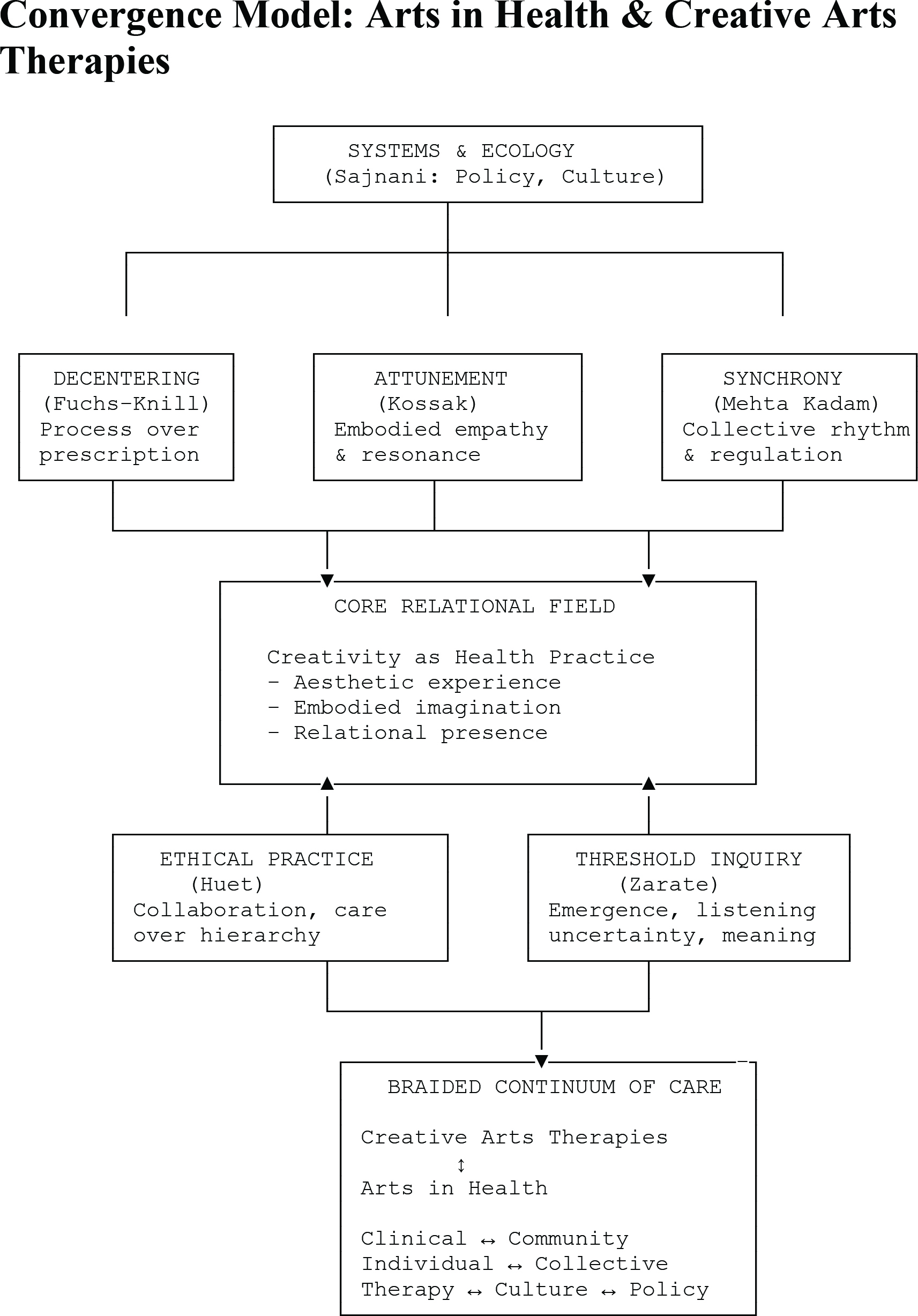
Figure 1. - A convergence model illustrating how Creative Arts Therapies and Arts in Health function as a braided continuum of care, grounded in a shared relational-aesthetic field and shaped by processes of decentering, attunement, synchrony, ethical collaboration, inquiry, and systems-level engagement.
The panel discussion begins with Prof. Margo Fuchs Knill, Ph.D. who is the founding Dean of the Division of Arts, Health and Society at the European Graduate School (EGS). She guided the development of the master’s programs in Expressive Arts Therapy, Coaching & Consulting, and Conflict Transformation & Peacebuilding (1996–2017), and was Dean of the Division of Arts, Health and Society from 2017 to 2023. Her academic and clinical work centers on intermodal expressive arts therapy, art-based research, supervision, coaching, and curriculum development. Her approach is poetic, resource-oriented, and phenomenological, building on Knill’s concept of Intermodal Decentering (IDEC®).
This approach to the use of the arts in health and therapy is drawn from the work of Knill et al. (2023) and is focused on the use of intermodality in expressive arts practice, along with artistic de-centering practices and finding artistic solutions to challenges. Solutions are often structured, and many solutions can sometimes emerge as surprises. Paolo Knill’s foundational contributions to expressive arts theory offer a vital lens for understanding the relationship between Creative Arts Therapies and Arts in Health. His emphasis on de-centering and the deliberate shift away from problem-solving and interpretation toward aesthetic engagement resonates across both fields, inviting practitioners to trust the creative process rather than impose solutions upon it. Knill’s concept of intermodality, i.e., the movement between artistic forms as a source of knowledge in itself, dissolves rigid disciplinary boundaries and mirrors the way Arts in Health and Creative Arts Therapies flow along a continuum rather than occupy fixed positions. Within Arts in Health, this orientation supports non-clinical, community-based, and culturally embedded practices that privilege participation, resonance, and relational meaning-making; within Creative Arts Therapies, it safeguards the integrity of creative depth while resisting reductive outcomes. Together, Professors Margot Fuchs Knill and Paolo Knill’s thinking affirms a shared ethic across both domains. That is, healing emerges not from fixing, but from attending, through image, movement, sound, and story, to what wants to be known. In this way, expressive arts theory offers a decolonial sensibility, one that recenters process over prescription, relational aesthetics over authority, and creativity as a living field in which health is continually co-composed.
The next panelist, Dr. Mitchell Kossak, is a Professor in Expressive Therapies and Counseling at Lesley University, Cambridge, Massachusetts. He is a Past Co-President of IEATA (https://www.ieata.org), the International Expressive Arts Therapy Association. He is also the Associate Editor of the Journal of Applied Arts and Health. He is the author of Attunement in expressive arts therapy: Toward an understanding of embodied empathy (Kossak, 2022). In, 2019 he helped to create Voces Arts and Healing to work with asylum seekers in Juarez, Mexico. Dr. Kossak is also a professional musician, performing for the past 40 years in the Boston area. In this webinar, Mitchell’s focus is on the history of creative arts therapies and his involvement in the International Expressive Arts Therapy Association (IEATA) and the development of the expressive therapy section of the National Organization of Arts and Health’s (NOAH) Core Curriculum.
Professor Mitchell Kossak enters the dialogue as both historian and listener, rooted in the professional lineage of the Expressive Arts Therapies and attuned to the deeper currents that predate their formalization. Drawing on his long involvement with IEATA, his editorial role within the Journal of Applied Arts and Health, and his contribution to NOAH’s Core Curriculum, Kossak situates the Creative Arts Therapies as a field that emerged in the mid-twentieth century through humanistic and transpersonal psychology, while remaining grounded in much older ways of knowing. He reminds us that sound has always been present in healing, as vibration, resonance, and attunement, echoing traditions in which music and medicine share a common root, as in Chinese philosophy. From his professional home at Lesley University to his community-based work with asylum seekers through Voces Arts and Healing in Juárez, Kossak’s perspective bridges clinical depth and cultural humility. His emphasis on imagination, pulsational balance, and embodied empathy reframes the relationship between Creative Arts Therapies and Arts in Health not as a question of boundaries, but of listening: to rhythm, to context, to the ways creative practice helps make meaning in a world that often feels senseless. In this way, his voice affirms a shared ethic across both fields, one that understands healing as attunement rather than solution, and creativity as a resonance that connects individual experience to collective care. His articulation of aesthetic attunement situates therapeutic encounters not merely in verbal processing but in rhythmic, sensory, and intermodal responsiveness.
In Applied Arts and Health (Kossak et al., 2022) frame applied arts practice as a bridge across therapy, education, and community health sectors. Here, the expressive arts are neither confined to psychotherapy nor diluted into entertainment; they function as relational and ecological processes of meaning-making.
The next panelist, Devika Mehta Kadam, is a registered Dance Movement Psychotherapist (R-DMP) with a comprehensive background in expressive arts and clinical practice. She currently serves as the Program Head for the Post Graduate Diploma in Expressive Arts Therapy at St. Xavier’s College, Mumbai. She holds significant international roles, including being a Founding Board Member of the Indian Association of Dance Movement Therapy (www.iadmt.org) and the Regional Director (Asia) and Executive Board Member for the International Association of Creative Arts in Education and Therapy (www.iacaet.org). Her research focus is on embodied indigenous knowledge, decolonising bodies, and neurorehabilitation. She would like to be involved in opening the circle to bring this work to a policy level.
Devika Mehta Kadam extends this dialogue by taking it into a short movement exploration through the language of the body in motion. She brings her work into view as both a clinical principle and a cultural ethic. As a dance movement psychotherapist, educator, and co-founder of Synchrony, her work emerges from the lived intelligence of the body, where healing unfolds through timing, rhythm, and shared movement. Rooted in embodied Indigenous knowledge systems and attentive to the decolonization of bodies shaped by colonial and biomedical hierarchies, Mehta Kadam reframes synchrony as a relational field, as one that restores regulation, agency, and belonging through collective rhythm. Her leadership within the IADMT and IACAET situates this work within a global exchange, where expressive arts therapy and arts in health are understood as interwoven practices rather than separate domains. Devika Mehta and global initiatives such as Synchrony demonstrate how in non-Western contexts, these distinctions are often less rigid and that uses of the arts cross over boundaries to include ritual, therapy, and community healing, which may coexist within integrated paradigms (Synchrony India).
In conversation with Knill’s decentering and Kossak’s attunement, synchrony becomes a bridge, linking neurorehabilitation, community practice, and policy imagination, inviting the field to move beyond and towards resonance, and toward systems that recognize embodied connection as a foundational condition of care.
Dr Val Huet, IACAET President, brings to this dialogue the long view of institutional memory and ethical leadership, shaped by decades of practice at the intersection of art therapy, group work, organizational systems, and creative health. Drawing on her experience as Chief Executive of the British Association of Art Therapists and her sustained partnerships with Arts in Health organizations across the UK, Huet reflects on a history in which arts therapies and creative health were once positioned in opposition and competing for legitimacy, resources, and voice, only to discover that such divisions served neither practitioners nor those they sought to support. Her work models a different stance: one that resists cynicism and protectionism and instead holds difference as a generative condition. In the UK context, where creative health practitioners often facilitate arts experiences without clinical credentialing and work often within museums, galleries, schools, and community spaces, Huet emphasizes that shared belief in creativity as fundamental to human experience outweighs professional demarcation. What matters, she argues, is not who claims authority over the arts, but how ethically, collaboratively, and responsively they are offered.
In conversation with Knill’s decentering, Kossak’s attunement, and Mehta Kadam’s synchrony, Huet’s perspective insists on keeping clients’ and communities’ needs at the center, especially amid rising anxiety, political polarization, and social fragmentation. Her advocacy for co-production, joint research networks, and shared leadership reframes collaboration as a practice of care: one that mitigates burnout, expands definitions of evidence, and refuses the weaponization of difference. In this way, her contribution affirms that the arts in health and creative arts therapies are not strengthened by narrowing identities, but by widening the circle and working together across systems so that creativity remains a lifeline, not a battleground.
Dr. Rebecca Zarate is a Professor of Arts and Health, Associate Dean for Research in the College of Fine Arts, and Director of the Arts & Health Innovation Lab, and Lead for the Vice President for Research Arts & Health Working Group, University of Utah. She was formerly an associate professor of music therapy in the department of Expressive Therapies at Lesley University, USA. Her research focuses on anxiety and improvisation-based music therapy, and she has secured several program and research development grants (Zarate, R. 2022). Dr. Zarate is interested in the clinical, social, and cultural intersections of anxiety and writes and presents on this from clinical, critical, and cultural perspectives.
Dr Rebecca Zarate enters the dialogue, asking the field to pause and listen. She asks important questions, such as, where are we now? How did we arrive here? And what might make the arts make possible next? Drawing on decades of clinical practice and research in trauma-informed and improvisation-based music psychotherapy, her work sits at the confluence of anxiety, sound, culture, and meaning-making. From her leadership in Arts and Health at the University of Utah to her roots in expressive therapies at Lesley University, Zarate embodies the widening scope of the field: that is, one that moves beyond individual clinical encounters toward social, cultural, and policy-facing impact. Through her research on anxiety, she reminds us that change does not emerge only from technique, but from understanding the deeper psychological and spiritual processes through which human beings regulate, connect, and transform. In conversation with Knill’s decentering, Kossak’s attunement, Mehta Kadam’s synchrony, and Huet’s ethics of collaboration, Zarate calls for rigorous research that remains artistically and reflexively grounded. She is involved in research that can name change factors, inform practice, and advocate for resources without losing the soul of the work. Her attention to improvisation, collective symbolism, and what emerges from the shared unconscious, reframes Arts in Health and Creative Arts Therapies as practices that teach societies how to listen. This involves listening to anxiety as a signal, to art as knowledge, and to creativity as a sustainable mechanism for health. Standing at this threshold, she points toward a future that demands strategic planning, global research alliances, and policy fluency, while still coming from the heart, trusting that the arts, when held with integrity, reach beyond the individual toward collective healing.
Professor Nisha Sajnani, the closing panelist in this global gathering, is Director of the New York University (NYU) Steinhardt Graduate Program in Drama Therapy, Director of the Arts & Health initiative at NYU, and Founding Co-Director of the Jameel Arts & Health Lab, established in collaboration with the World Health Organization (WHO), to measurably improve lives through the arts (New York University, n.d.; Jameel Arts & Health Lab, n.d.; Sajnani & Fietje, 2023). Through the Lab, she consults with city and country governments, cultural institutions, and academic centres, to map and mobilize the arts as a health resource. Professor Sajnani, a widely published author, leads the Jameel Arts & Health Lab–The Lancet Global Series on the Health Benefits of the Arts (Jameel Arts & Health Lab, n.d.). An award-winning author, educator, and advocate, her work explores the unique ways in which aesthetic experiences can inspire equity and care in the service of public and planetary health.
Professor Sajnani brings the conversation outward, across borders, systems, and scales by insisting that arts and health must be understood as a living ecosystem rather than a bounded field. Through her leadership at NYU and the Jameel Arts & Health Lab, established in collaboration with the WHO (https://www.who.int/initiatives/arts-and-health), she reframes artists, educators, and therapists as cultural producers who also carry responsibility as advocates, researchers, and translators of knowledge. Her work calls for permeability, for an openness to how health policies can help or harm, how social and ecological determinants shape wellbeing, and how the arts move people toward or away from one another. The Jameel Arts & Health Lab, working in collaboration with the WHO, positions arts and health within policy, economics, and systems of change. Nisha Sajnani’s work at the Jameel Arts & Health Lab emphasizes cultural humility, social justice, and systems-level transformation. Sajnani argues that arts in health must avoid instrumentalization; instead, it should preserve the intrinsic, dialogic, and ethical nature of artistic encounters.
In dialogue with Knill’s decentering, Kossak’s attunement, Mehta Kadam’s synchrony, Huet’s ethics of collaboration, and Zarate’s threshold thinking, Sajnani emphasizes continuity between everyday cultural participation and clinical care, between local traditions and global evidence, between aesthetic experience and public policy. The Lab’s global mapping of practices, its hub-and-spoke model of governance, and its commitment to open-access knowledge, including visual essays that capture public consciousness, demonstrate how theorizing the benefits of arts in health also sustains the arts themselves. By lifting up shared values across the lifespan while honoring regional and Indigenous traditions, her work resists closure and hierarchy, offering instead channels held by an ethic of care. At this scale, arts and health are no longer only a profession or a practice. It becomes a relational infrastructure, one that helps societies listen, respond, and imagine health as something cultivated together, across cultures, crises, and futures yet unfolding.
CONCLUDING THOUGHTS
This dialogue situates the relationship between the creative arts therapies and arts and health as allied fields, shaped by multiple lineages and increasingly connected through shared frameworks, research, and ethical commitments. International initiatives such as the International Association of Creative Arts in Education and Therapy (IACAET) reflect a growing recognition of the need for dialogic credentialing processes that can support practitioner mobility, cultural responsiveness, and professional integrity across global contexts. Rather than imposing uniform standards, IACAET’s approach emphasizes relational accountability, shared competencies, and respect for regional traditions in arts in health, education, and therapy.
As illustrated in Figure 1, the relationship between Arts in Health and the Creative Arts Therapies unfolds through interconnected processes such as decentering, attunement, synchrony, and ethical collaboration.
Complementing this global orientation, the National Organization for Arts in Health (NOAH) has played a critical role in articulating professional competencies through its Core Curriculum and White Paper, offering a structured yet inclusive framework that clarifies distinctions and intersections between arts in health and the creative arts therapies. These efforts contribute to a shared language for training, practice, and advocacy, while acknowledging the field’s interdisciplinary nature and diverse points of entry.
At the level of research and policy, the Jameel Arts & Health Lab, in collaboration with the WHO, has advanced a robust global evidence base that positions the arts as a vital public health resource across the lifespan. Through international mapping, translational research, and policy engagement, this work strengthens the field’s capacity to inform systems of care without reducing the arts to instrumental outcomes.
IACAET, under the leadership of Tony Yu Zhou, has played a pivotal role in advancing this vision. Through its commitment to intercultural dialogue, open-access scholarship via the CAET Journal, and the development towards an internationally informed credentialing process, IACAET offers a model of professional recognition grounded in relational ethics rather than prescriptive standardization. Its dialogic approach acknowledges multiple epistemologies, scientific, artistic, indigenous, and embodied, and affirms that competency in arts and health must be understood as culturally situated, ethically accountable, and responsive to local knowledge systems.
Vivien Speiser occupies a generative position in the dialogue between Creative Arts Therapies and Arts in Health, not merely as a contributor, but as a bridge-builder across clinical, educational, and global health domains. Her work demonstrates that the convergence of these fields is not a dilution of therapeutic rigor, but an expansion of relational, aesthetic, and ethical practice into wider social ecologies. Speiser’s scholarship foregrounds trauma-informed, culturally responsive, and relationally attuned approaches to expressive arts practice. In contexts shaped by displacement, intergenerational trauma, migration, and systemic inequity, she situates the arts not as adjunctive interventions but as primary modes of restoring narrative coherence and embodied agency. Her writing and convening work, including webinar dialogues and international exchanges, emphasize that this work must retain aesthetic integrity and relational depth even as it enters institutional and policy spaces.
Together, the leadership of Zhou and Speiser signals a movement toward the future that is neither fragmented nor homogenized, but intentionally dialogic. Their work situates credentialing not as a mechanism of exclusion, but as an ethical practice of care, one that asks about who is recognized, whose knowledge counts, and how responsibility is shared across borders. In this framing, professionalization becomes a means of safeguarding cultural humility, practitioner integrity, and community wellbeing rather than narrowing the field’s imagination (Speiser, V., & Zhou, T. Y. 2025; Zhou, T., & Marcow Speiser, V. 2023).
Tony Yu Zhou’s voice carries this responsibility across borders, articulating the arts in health, education, community, and therapy as a living bridge between Eastern and Western knowledge systems, science, and embodied wisdom. Trained in biomedicine and grounded in movement analysis and creative arts therapies, his work insists on dialogue rather than dominance, translation rather than imposition. Through institution-building, open-access scholarship, and global alliance, Zhou frames the field as one that must remain permeable while at the same time being capable of moving between languages, epistemologies, and cultural realities without losing integrity. Together, these orientations offer a final gesture rather than a conclusion: a commitment to keep the field open, relational, and in motion, guided by care, curiosity, and the shared work of making health possible through the arts.
Lyrical Coda
We heal in rhythm, in story, in the space between us.
And it is there between cultures, disciplines, and ways of knowing that the arts in education, community, therapy, and health continues its work: not to close the circle, but to keep it open.
ACKNOWLEDGEMENTS
This report was developed with the support of ongoing dialogues among global leaders in the creative arts therapies relationship to arts and health, curated through an IACAET global webinar, held on January 10th, 2026, entitled: Arts in Health and Creative Arts Therapies-convergences and intersections. This webinar was curated by Vivien Speiser and Tony Zhou on January 10th, 2026. The authors acknowledge the assistance of AI (OpenAI, 2025) in research synthesis, editing, and stylistic refinement under the authors’ direction. All interpretations, structure, and final content were curated by the authors.
AUTHOR BIOGRAPHIES
Prof. Vivien Marcow Speiser, PhD, BC-DMT, REAT, LMHC, is Professor Emerita and Co-Director of the Institute for Arts and Health in the Graduate School of Arts and Social Sciences at Lesley University. A dance therapist, expressive arts therapist, educator, and researcher, she has worked extensively with diverse communities across the United States, Israel, and internationally. Prof. Speiser is also a Distinguished Research Associate in the Drama for Life Programme at University of the Witwatersrand. She is the recipient of three Fulbright Senior Scholar Awards and several lifetime achievement awards from international professional associations in recognition of her contributions to the creative and expressive arts therapies.
Dr. Tony Yu Zhou is the Co-Founder and CEO of the Inspirees Education Group (Netherlands/China) and a pioneer in the development of dance therapy and creative arts therapies in China. Trained as a biomedical scientist, he has been actively engaged in the fields of modern dance, dance therapy, and expressive arts since 2002. He is the founder of Inspirees Institute and the founder/Publisher of Creative Arts in Education and Therapy (CAET): East, West and Global Perspectives, an international peer reviewed journal. A Certified Movement Analyst (CMA) and dance therapist, Dr. Zhou serves as Team Leader of the Chinese Group of Arts Therapy under the Chinese Psychological Society, Guest Professor at the Central Academy of Fine Arts in China, and Co-Founder of the World Alliance of Dance Movement Therapy (WADMT). He is also the Founder and Executive Director of the International Association of Creative Arts in Education and Therapy (IACAET).
CONFLICTS OF INTEREST
The authors declare no conflicts of interest related to this publication. The article is based on a webinar presentation and reflects the professional perspectives of the authors.
REFERENCES
Creative Arts in Education and Therapy journal platform. https://caet.inspirees.com/
| |
International Association for Creative Arts in Education and Therapy. . https://www.iacaet.org/
| |
International Expressive Arts Therapy Association. International Expressive Arts Therapy Association. https://www.ieata.org
| |
International Association for Creative Arts in Education and Therapy. IACAET arts and health global dialogue series. https://www.iacaet.org/iacaet-arts-health-global-dialogue-series/
| |
Jameel Arts & Health Lab. Nisha Sajnani. https://www.jameelartshealthlab.org/about/our-team/nisha-sajnani
| |
Jameel Arts & Health Lab. Lancet global series on health benefits of the arts. https://www.jameelartshealthlab.org/research/research-projects/lancet-global-series-on-health-benefits-of-the-arts-2
| |
Knill, P.; Eberhardt, H. Solution Art: A Textbook of Arts and Resource-Orientated Work; Jessica Kingsley Publishers, 2023.
| |
Kossak, M. Attunement in Expressive Arts Therapy: Toward an Understanding of Embodied Empathy, 2nd ed.; Charles C Thomas, Publisher, Ltd., 2022.
| |
Kossak, M.; Prior, R.; Fisher, T. Applied Arts and Health: Building Bridges across Arts, Therapy, Health, Education and Community; Intellect, 2022.
| |
Marcow Speiser, V. Creative and Expressive Arts Therapies; Albright, I. A., Carytsas, F., Eds.; National Organization for Arts in Health, 2021; pp 72–112.
| |
National Organization for Arts in Health. Publications. https://thenoah.net/publications/
| |
New York University. Nisha Sajnani. https://steinhardt.nyu.edu/people/nisha-sajnani
| |
Sajnani, N.; Fietje, N. The Jameel Arts & Health Lab in Collaboration with the WHO–Lancet Global Series on the Health Benefits of the Arts. The Lancet 2023, 402 (10414), 1732–1734. https://doi.org/10.1016/s0140-6736(23)01959-1
| |
Speiser, V.; Zhou, T. Y. Webinar Reflections: Perspectives of Arts in Health as a Discipline – Dialogue with World Leaders: History, Frontier, and Future, IACAET Webinar, November 1, 2025. Creative Arts in Education and Therapy (CAET) 2025, 11 (2), 347–357. https://doi.org/10.15212/caet/2025/11/17
| |
Synchrony India. Synchrony India. https://www.synchronyindia.com
| |
World Health Organization. Arts and health. https://www.who.int/initiatives/arts-and-health
| |
Zarate, R. Music Psychotherapy and Anxiety: Social, Community, and Clinical Contexts; Jessica Kingsley Publishers, 2022.
| |
Zhou, T.; Marcow Speiser, V. From Tradition to Diversity, Innovation, and Breakthrough: Key Conversations on Dance Therapy around the World. Creative Arts in Education and Therapy 2023, 9 (2), 209–225. https://doi.org/10.15212/caet/2023/9/17
|