The Construction of “Traditional”: Imaginative Reshaping of Chinese Classical Dance in an International Context
Volume 2, Issue 2, Pages 49-61
Abstract
Chinese Classical Dance has been developing for more than 60 years. This art form, which represents China to the world, is typically considered a national symbol. The author once taught Chinese Classical Dance courses and rehearsals as a visiting scholar at Cincinnati University in the United States. During this visit, she used her own experience and introspection to create two dance pieces.
This paper discusses the imaginative reshaping of Chinese Classical Dance in an international context. The author highlights the importance of reshaping Chinese Classical Dance, as it is a kind of cultural salute to traditional Chinese culture, and is on the verge of being lost as an art form. Additionally, Chinese Classical Dance is not only an artistic container for the ancient and profound Chinese culture and civilization, but also is seen as an timeless, utopian world that has long provided China with a sense of spiritual care for all of humanity.
This paper covers these key areas: firstly, the author’s thoughts on why Chinese Classical Dance needs to be reshaped, according to her American students’ perspectives on Chinese Classical Dance; secondly, during the rehearsals of the dance pieces named Chiaroscuro and Coexistence, the author considers how Chinese Classical Dance could be represented in an international context; thirdly, reflections on how to achieve the imaginative reshaping of Chinese Classical Dance; and lastly, conclusions regarding the physical practice of Chinese Classical Dance, as well as common human spiritual values and introspection that can be found in Chinese Classical Dance. This article includes video materials of the choreography of Chinese Classical Dance.
Abstract (Chinese)
中国古典舞已经发展了60多年。这种面向世界代表中国的艺术形式,通常被认为是一种国家象征。作者曾在美国辛辛那提大学作为访问学者,教授中国古典舞蹈课程和作品排练。在访问期间,她依据自己的专业背景和经验,以及对传统的反思内省,创作了两个 “古典” 舞蹈作品。
本文讨论了中国古典舞在国际背景下的想象性重塑。作者强调了重塑中国古典舞的重要性,对于中国古典舞处在失去艺术形式的边缘的现状,它是对中国传统文化的一种文化致敬。此外,中国古典舞蹈不仅是古老而深邃的中国文化以及华夏文明的艺术容器,也被视为一个永恒的乌托邦世界,长期以来中国为全人类提供的精神关怀感。
本文涵盖了这些关键领域:首先,根据作者的美国学生对中国古典舞蹈的观点,作者阐释了为什么中国古典舞需要重塑的思考;其次,在名为 “明暗” 和 “共存” 的舞蹈排练期间,作者思考了中国古典舞在国际背景下如何表现;第三,思考如何实现中国古典舞的想象性重塑;最后,基于中国古典舞创作实践,在中国古典舞中找到人类共同的精神价值观和内省。本文包括中国古典舞蹈的编排影像资料。
Keywords
International context, Chinese Classical Dance, traditional Chinese opera, history, imagination, cross-cultural exchange, dance education.
关键词
国际情境, 中国古典舞蹈, 中国传统歌剧, 历史, 想象力, 跨文化交流, 舞蹈教育.
History
Received 01 September 2016
Accepted 28 October 2016
Open Access
This is an open access article.
The development of Chinese Classical Dance already has 60 years of history. In 1954, with a strong desire to construct a dance system featuring national characteristics, predecessors of the Chinese dance circle began to build Chinese Classical Dance based on traditional Chinese opera with reference to ballet. This started with the construction of instructional dance materials. These mainly had traditional Chinese opera and martial arts as a basis, integrated with ballet training methods to formulate a set of training materials entitled “Basic Training of Chinese Classical Dance,” intended for the training of actors and actresses. In the 1980s, Chinese Classical Dance opened up a form called “Body Rhythm” which moved away from external appearances and toward internal embodiment. This expanded the range of possibilities for Chinese Classical Dance significantly. By the end of the 20th century, Chinese Classical Dance had become a more mature form and could function as an independent genre in various types of dance competitions. At the same time, it does hold a certain ambiguity: its emphasis is not only on specific skills and techniques but also on the fusion of other forms such as ballet and modern art. However, since the turn of the new century, Chinese Classical Dance has once again taken a new turn in response to public dissatisfaction with its form.
In 2001 “Han and Tang Dynasties Classical Dance”, a dance academy in Beijing, was officially set up. Mr. Sun Ying, its founder, constructed an entirely new discourse for Chinese Classical Dance. In 2006, the “Kun Dance” program, taught by Prof. Ma Jiaxin at Nanjing University of the Arts, had its debut. In 2008, Beijing Dance Academy recruited its first batch of undergraduates who would specialize in “Dunhuang Dance.” In 2009, Prof. Liu Qingyi organized an evening presentation entitled “Lingering of the Elegant and Authentic Music of Southern Song Dynasty (nansong yayue yixiang)” at Hangzhou Normal University. In Taiwan, “Liyuan Dance” by Ms. Chen Mei-e and the rebuilding of “Tang Yue Dance” by Mr. Liu Feng-xue presented to us a completely new aspect of classical dance through expanded body movements, opening a much wider perspective in terms of its stage performance and creation.
Notwithstanding, where exactly does Chinese Classical Dance stand? Though it has been my professional field for nearly twenty years, and I have taught it for eight years, still, my understanding of it is not complete. We need to further expand its definition and respond to questions concerning its variations.
From Summer 2014 until Summer 2015, I had the chance to teach Chinese Classical Dance and a Rehearsal course in the Dance Department of the Conservatory of Music at the University of Cincinnati as a visiting scholar. At the end of the semester, two dance pieces were to be presented by the students, at performance standards, in the Cobbert Theater of the University of Cincinnati. My teaching experience that year required me to grow in both teaching and learning, and I began to think more deeply and clearly about Chinese Classical Dance.
The following is a discussion of the imaginative reshaping of Chinese Classical Dance in an international context and the common spiritual value of mankind beyond culture and nationality, based on my experience as a visiting scholar. I will also discuss the physical practice of Chinese Classical Dance and its effects on the bodies of trans-national dancers, and will offer a reflection on Chinese dance education and teaching from the American dance education perspectives.
1. Why Reshape Chinese Classical Dance
1.1 “Chinese Classical Dance” As Defined By American students
When teaching Chinese Classical Dance, the most difficult part is to find an appropriate introduction. Although Chinese Classical Dance is a body-based practice, it is also part of Chinese culture.
As a teacher of American students who knew almost nothing about Chinese culture and dance, I needed not only to teach physical and body language, but also to engage their imaginations around Chinese culture. For instance, I offered them some photos related to the stone relief of the Han Dynasty and the dancing form in the Dunhuang frescoes, and I also provided background descriptions of the history of Chinese dance. During the last class of each week, I asked the students to discuss their perception of the Chinese Classical Dance courses. I also tried to illuminate the historical aspects of Chinese dance culture. In our introductory sessions, I depicted historical dance image and postures, and encouraged my students to imitate the “body” and “form” and even to feel the “aura”—through breath and rhythm—of Chinese Classical Dance.
I was most impressed when, during a discussion about Chinese Classical Dance, I asked students how they felt in this class, or how it compared with their routine ballet training class and modern dance training class. They said that they liked this style of dancing, especially the “transverse center of gravity” and the “internal rotation and twist inclining of the body” of Chinese Classical Dance. American dancers’ bodies are rarely “spiral twisted” and their bodies are directed very clearly upwards, in ballet, or grounded, as in modern dance. Therefore, the “curve consciousness” that appears in Chinese Classical Dance would be quite difficult for them to fully experience. Chinese Classical Dance emphasizes backwards first before forwards, right first before left, and downwards first before upward. Consequently, more and more circuitous routes are required by the body. I was very pleased to hear my students’ perspectives, because this is also my understanding of the physical reality of Chinese Classical Dance.
What seems interesting is the way they defined Chinese Classical Dance: “Chinese Classical Dance is the Chinese modern or contemporary dance.”
This definition surprised me, and pushed me into deep thinking. The emergence of Chinese Classical Dance occurred in the 1950s; however, we have never been questioned about the issue of authenticity. My teacher and her teacher both told me that THIS is Chinese Classical Dance. However, since the new century, as mentioned above, there have been different voices in classical dance. Different forms of dance appeared, and this, we have to say, questions the “validity” of Chinese Classical Dance. The definition of the dance has never been made clear. In the United States, the definition as given by these American students suddenly inspired me because perhaps their expression is more appropriate: Chinese Classical Dance was indeed “reshaped” only in the 1950s, hence it can be allocated into the “contemporary” category.
1.2 Why Chinese Classical Dance Needs “Reshaping”
Then, why does this kind of contemporary art/Chinese dance style need to be reshaped? Does it not have its own form? The answer is that dance can never be truly recorded.
Jose Limon is a master of modern dance and founder of the Limon School, one of the five major schools of Western modern dance. Limon said: “Dance is a moment, then it is finished.” The meaning of this sentence is that dance is instantaneous and momentary: it disappears very quickly. Therefore, we say that dance is in the present. I stand here; I dance and dance is the present; I stop dancing, and though my body is here, the dance no longer exists. There is a saying: “Once the painting is complete, the work remains there even if the painter leaves. However, if the dancer leaves, the work is gone too, because the body of the dancer is the medium of the work, and it is the dancer that carries this work of art in him/herself.”
Dance is not a word or a theory, but a real dynamic representation. The dance of the past is no longer traceable, and the image recordings we can see today are just photos or pictures of dancing postures. The truth or facts of the dance of the past have already been mostly lost. Therefore, we need to reconstruct it. Chinese Classical Dance is not inherited from ancient times, but modern construction achieved by contemporary dance artists.
2. What New Shapes Can Chinese Classical Dance Take?
2.1 Creation of Chinese Classical Dance: Chiaroscuro and Coexistence
Teaching made me reflect upon why Chinese Classical Dance needs to be reshaped while, in the process of choreography, I pondered over the issue of what kind of Chinese Classical Dance could gain international recognition after reshaping.
Strictly speaking, these two pieces cannot be labeled as Chinese Classical Dance. Nevertheless, it seems to be certain that they are recognized by the international dance society as “Chinese” dance. The first piece was a group dance called Chiaroscuro. The work lasted 10 minutes and was performed by 10 American students. The name of the dance piece comes from Italian, and is often used in fine arts terminology, implying light and shade contrast. Therefore, in Chiaroscuro, I was trying to search for something with antithetical elements, such as Yin and Yang in ancient Chinese philosophy. I was looking for a striking contrast in this work, perhaps through costumes, lighting, movements, or even rhythm. I chose Chinese style long robe-type Taiji suits for costumes, white in the front and black in the back. When the actor/actress turned around, a sense of collision between the black and white would appear on the stage. For lighting, I used the black and white Yin and Yang fish drawing, and two groups of people who flickered inside the light alternated with light and dark. For movement, I used “holding the ball” and “pas de cheval (ma bu)” in Taiji. I used “Masteral Spiral (Chan Si Gong)” for force exerting in the fighting scene. As the two groups of people fought each other, I introduced a kind of martial art. During the grand climax of the performance, I used “running field steps (paochang bu)” in the classical dances of the Han and Tang dynasties, and “pas de cheval (ma bu)” was also a highlight where the vigor, the momentum, and the imposing manner of the Chinese martial arts
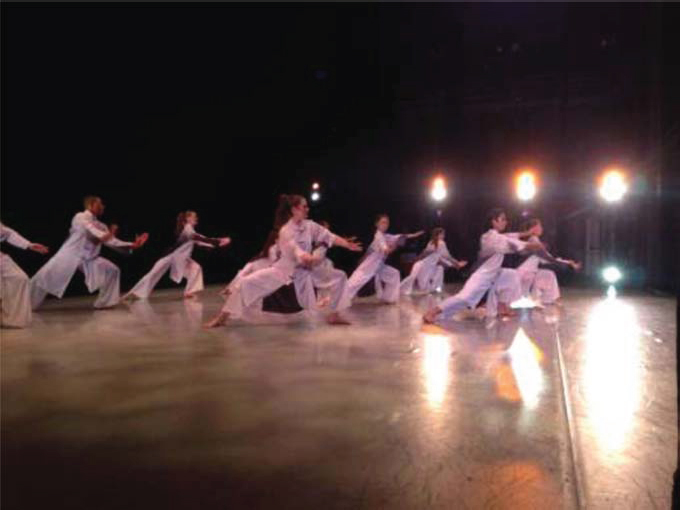
(gong fu) and Taiji can be well-represented.
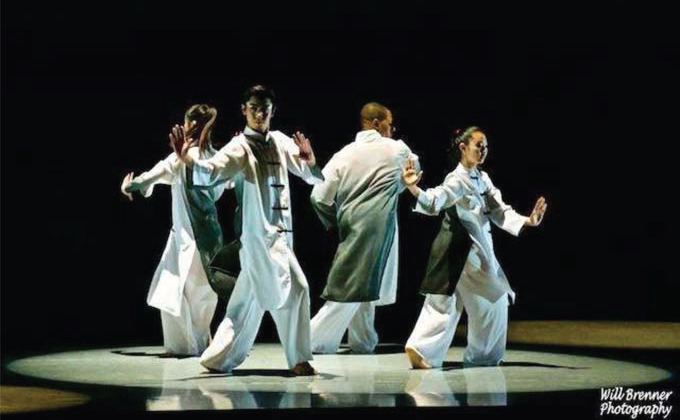
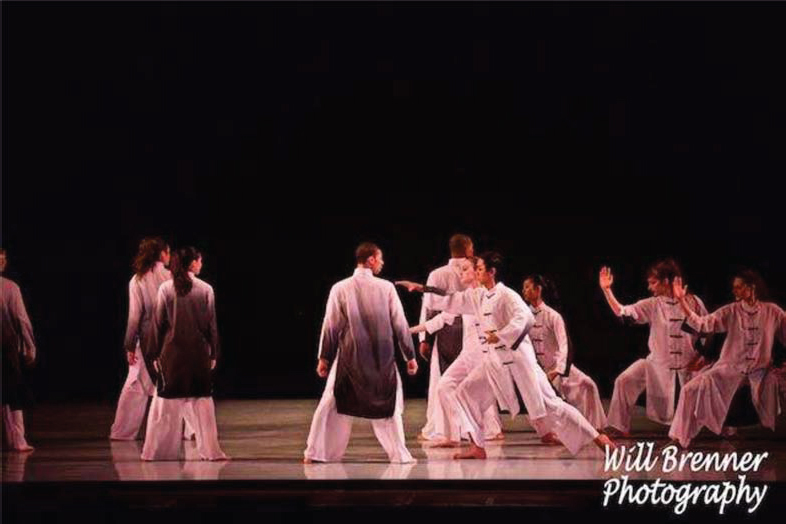
Chiaroscuro Choeography by TIAN Tian (2015) Photoes by Will Brenner
I had never thought that the American students would have loved this dance as much. They liked the feeling of the intrinsic transverse center of gravity, and the flow of qi in Chinese Taiji and martial arts. In Chinese dance, a lot of energy comes from qi, pas de cheval (ma bu) or horse stance, and an emphasis on a low center of gravity.
The other dance piece was the pas de deux, or, as named, Coexistence, performed by two Chinese students. The creation of this piece has a story: the school had two Chinese students who needed to perform, but ballet was not these Chinese students’ specialty. Therefore, their American advisor invited me to create a Chinese dance piece. Based on the disposition or temperament of these two students, I chose fan chuan as a theme for the drama. According to this arrangement, the male danced the female character, and the female the clown character. They both stood on the stage together, and opened the show with 科步 (ke bu). In the first half of the show, they put on their respective costumes, each wearing a mask, and had their respective solo performances; in the second half, both performers took off their costumes, removing also their masks, dressed in nude, unlined garments, showing completely their own natural and authentic existence, and encountered each other. This section had leanings toward conventional modern dance.
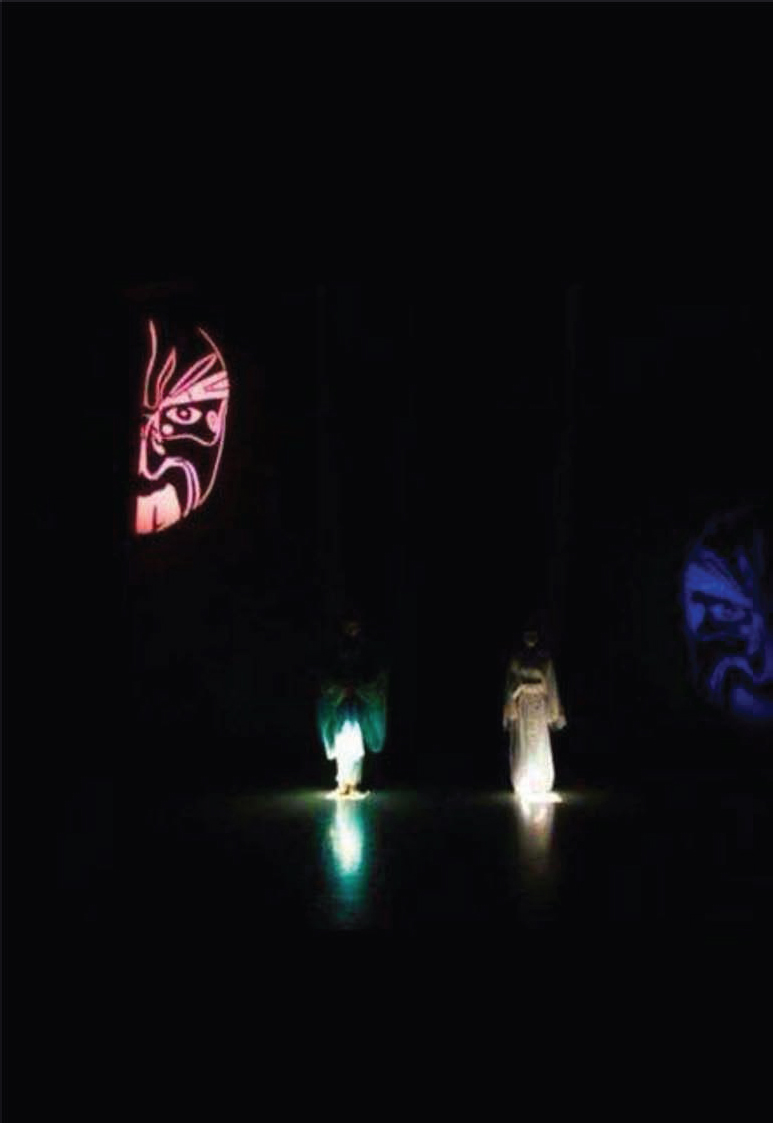
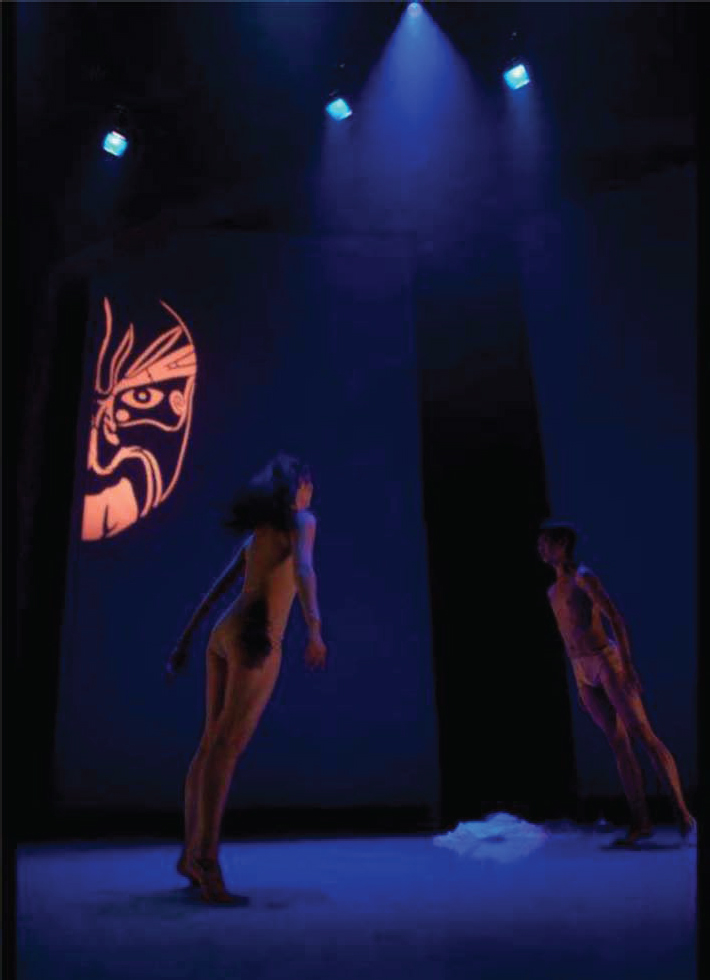
Coexsitence (2015, Cincinnati) Choreographer by TIAN Tian Dancers: ZHANG Xin-yi, LUO Tian
In this work, the key is how to link up the traditional part of Kebu (科步) in the Liyuan Opera of the first half and the section of modern dance of the second half. I used Liyuan Kebu (梨园科步), with finely-broken steps, to connect this four-section 10 minute work. What the work intended to express is how the mask covered their real faces. In the end, they took off their costumes and removed their masks, revealing their genuine bodies and facial features. Because of this, the word Coexistence offered a much wider implication: i.e.:
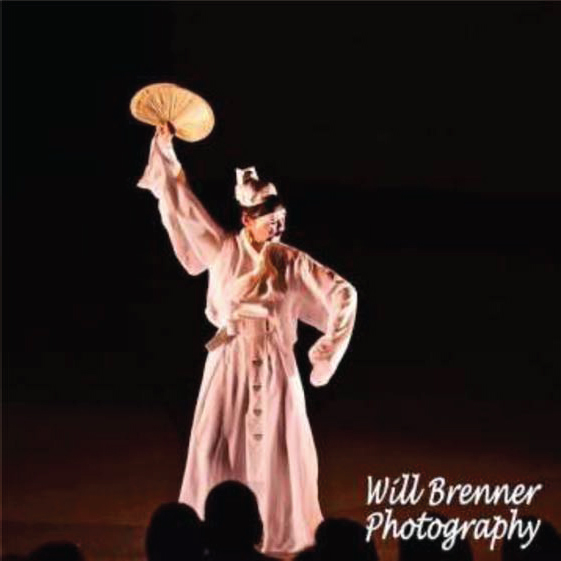
The Clown Character. in Coexistence photo by Will Brenner (2015)
Coexistence of male and female, beautiful and ugly, East and West, traditional and modern, as well as other antitheses that Yin and Yang contain.
2.2 Which Aspect of Chinese Classical Dance Should Be Reshaped?
For the two pieces, Chiaroscuro and Coexistence, I drew upon at least two inspirations: firstly, both pieces were closely related to my own background and interests. The reason I used Taiji and Liyuan Opera in the creation of this choreography is that I studied Kunpeng Taiji from Liu Junxiang, professor and research fellow of the Chinese National Academy of Arts, and Liyuan Opera from Chen Mei-e, professor of Han Tang Yue Fu (An art institution assuming the functions of a government office in the Han and Tang dynasties for collecting folk songs and ballads.) in Taiwan, both for about four to five years. Because of my specific background here, all my energy and knowledge could be fully motivated and put into use during my artistic creation. These are the elements I have inside me and I can therefore produce this kind of dance work. Other choreographers have different things inside themselves and, naturally, they can produce different dance pieces from those places.
Secondly, my imaginative reshaping of Chinese Classical Dance, or, perhaps, of Chinese dance, is not my spontaneous thinking but a logical interpretation. My hypothesis is based on aspects of the “old,” of the “past.” What matters the most is the cultural context of the “past” that constitutes the core link to “things of the old.”
As a choreographer, I don’t care whether this dance piece belongs to the category of Chinese Classical Dance. What I want to represent is its internal connection and cultural relevance as Chinese. Though neither of these pieces are Chinese Classical Dance as we know it traditionally, the genre is implied with the core of Chinese culture instead of a superficial presentation. In fact, many pieces of Chinese Classical Dance don’t look “Chinese,” while other, such as “Shui Yue” (水月) (water and moon), “Song of the Vagrant” (流浪者之歌) by Lin Huaimin of Taiwan, and “Spring Sacrifice” (春之祭) by Shen Wei (沈伟), an American-Chinese choreographer, have more of a “Chinese” feeling.
Because of these two pieces, I earned great fame, which helped me realize that we should fully comprehend and respect our own culture before expecting international dancers or choreographers to respect us. It was also during this rehearsal that my relationship with Chinese Classical Dance, which used to focus only on teaching, expanded. I began to contemplate how Chinese Classical Dance can manifest its authentically Chinese feel in an international context, still staying true to the culture while on stage. I realized that my focus was not on demanding that my American students’ movement look like classical dance, or even explaining to them what Chinese Classical Dance is; rather, I hoped they could feel in their bodies the qi and the flow as emphasized in the Chinese culture through my courses. Hence, with their bodies and hearts, they could feel Chinese culture and aesthetics, thereby coming to understand Chinese Classical Dance. After all, dance is a form of cultural expression.
2.3 How to Reshape Chinese Classical Dance
In the aforementioned discussion, we expounded upon why we should reshape Chinese Classical Dance and which aspect of it should be reshaped. In the following, I will explore how to reshape Chinese Classical Dance.
2.3.1 Formation
First of all, the contemporary form of Chinese Classical Dance has been achieved through formation, or form-structuring. “As a kind of basic element of human thinking, formation, or form-structuring is different from logical and conceptual form of thinking. Its product is not concept, judgment and reasoning, or a theoretical thought, but a creative representation.” (Zhang, J.,2010) In a traditional Japanese theatrical theory, a similar concept is called “conformation,” or kama: literally, “attitude” and “body posture”; that is, basic body posture and structure. In his book entitled Das Problem der Form der Bildenden Kunst (The Problem of Form in the Figurative Arts), Adolf Von Hilderbrand also put forth the concept “conformation” and pointed out that “conformation” and “imitation” are contradictory to each other. In imitation, art can tie or restrict the creation of an artist, whereas the problem of form as caused by the form of “conformation” has been regarded as an essential art issue.
Today, various types of Chinese Classical Dance have all been created by aesthetic conformation. As we have no evidence of the ancient dance, dance cannot be treated as a word or theory but only as a kind of real dynamic image.
Contemporary classical dancers and choreographers have reshaped the form of Chinese Classical Dance based on their understanding and interpretation of tradition, while also relying on their understanding of the multiple sources from which it emerges. Different approaches lead to different results. In other words, different types of classical dance represent different channels and dimensions of different artists when entering the “empty land” of the language of Chinese Classical Dance. However, regardless of the multitude of approaches, none of these elements is coming from arbitrary thinking; instead, it is based on each artist’s own construction.
2.3.2 “Conformation” In Two Dimensions
I would like to further explain two main dimensions and approaches of reshaping, focused on (1) the study of the extinct traditional (Chinese) opera and (2) resurrection of the extinct ancient dance form. Reshaping in the first dimension refers to the construction of opera dance that takes zuo da (做打)3 as a basis. Chinese Classical Dance always had opera as its basis, extracting materials from the Peking Opera, Kun Opera and other traditions. The opera forms were classified selectively according to their different natures and their action-based specifications and requirements. This is how the didactics of classical dance worked. “Kun Dance” and “Liyuan Dance” appeared subsequently. “Kun Dance” is a dance derivative of the Kun Opera, which is a kind of dance style created by the art of singing (chang) and the art of dance movement (zuo) of Kun Opera as its raw materials with profound classical cultural embodiment. “Liyuan Dance” took its origin from the Liyuan Opera of Quanzhou, Fujian Province, in which Sheng (male character), Dan (female character), Chou (clown) and the language system used for Liyuan all emerged directly from “opera.”
Reshaping in the second dimension (resurrection of the extinct ancient dance form) requires the thought of Chinese Classical Dancers and choreographers who based their work on historical and written archives. This brought classical dance much closer to the real features of ancient dance. Compared to the former dimension, this approach requires more academic background and ability to extract historical and archeological resources. If construction under the opera dimension is “from being to having,” “from alive to living,” then construction under the historical dimension would be “from nothing to being,” “from dead to living.” “From nothing to being” refers to the fact that it does not depend on concrete living form; “from dead to living” refers to the fact that it transforms the stereotyped and changeless form of “death” to a form of living, flowing dance. Therefore, the construction of the form of Chinese Classical Dance must be achieved under traditional Chinese culture. In this process, artists “reconstruct Chinese Classical Dance either based on the dance image of the ancient cultural relics, or extracting certain stylized actions from opera and martial arts, or using for reference the ballet experience in its systematic training.” (Tian, T.,2013)
Both the historical records and the opera originate from traditional Chinese culture. The formal tradition that was shaped in the past becomes the evidence of our present-day reconstruction. Chinese Classical Dance is presented with certainty in terms of modeling and posture. The most important part is that it offers us its present-day aesthetic implications.
2.4 Physical Practice of Chinese Classical Dance
It’s very interesting to watch American dancers perform Chinese Classical Dance. No matter how meticulously you demand their bodies to be “spiral-twisting” or “bending,” no matter how educated they are in feeling the inner rhythm, what they present in the end still includes their limited understanding and their cultural background. When given the instruction of “round” or “bend,” they will do what you asked for; however, this expression and cultural attribute would still be their own.
Namely, American dancers might share the same feeling of seeing me performing modern dance. It should be said that the cultural attributes in my body are a combination of my own cultural and training background as well as my own performing style. In the United States, I am relieved to see that teachers do not judge the students, but instead encourage them to find their own body patterns as dancers.
Then, why do American dancers inevitably lack something when performing Chinese Classical Dance? From a fundamental point of view, this is still a cultural problem. A body, even if it has not been “polished,” would still be a body endowed with the harmony of body and mind, which is a cultural entity that takes mutual permeability of the body and the mind as premise.
Ancient Greeks loved to show off their physical beauty, which can be seen in ancient Greek and Roman sculptures. The modern West presents body in an anatomized and organic way, which can be observed from Western natural science. This is clearly exemplified by the division and analysis of joint and muscle. Conversely, traditional Chinese culture and arts preferred a body of “opening and experiencing,” a body as alive.
In Chinese classical aesthetics, body is not just the flesh in its biological or physiological sense but an exuberant and lively body-mind structural system formed from a dynamic fusion of body and soul, feeling and thinking, sensation and reason, as well as subject and its object of attention. Such a “body-mind” structure endows the Chinese body with an integrated life experience. Traditional Chinese culture believes that heaven, earth, man, and the whole myriad of things are generated and formed by the most fundamental element called qi, so that the whole universe is in harmonious and orderly unity. Consequently, each part of life actually reflects the truth of the whole, as so vividly described in the saying: “To see a world in a grain of sand, and a heaven in a wild flower.” Therefore, in contrast with the dichotomy and separation of body and soul in Western cultural contexts, body in Chinese philosophical aesthetics was signified as a unified part, integrating both the body and the soul, which also symbolized the basic pattern of integration of the man and the universe.
Therefore, just like a man needs to be educated gradually, the body of Chinese Classical Dance is indeed not a simple simulation of external appearances. It needs to be cultivated slowly, in the manner of qi, which is the core element of Chinese Classical Dance. As Shaun McNiff stated in the Understanding of Art and Man—Chinese Style Focus, “the circulation of creative energy (vital energy/life force of ch’i/qi 氣) through our bodies and environments that will treat blocks and manifest the intelligence of imagination operating a few steps ahead of the reasoning mind that takes on the role of a witness responding to what happens outside its controls and plans (wu wei 無為)” (McNiff, S., 2015). It is the invisible qi, the flow of energy that breaks through the main and collateral channels, circulating through the whole body, connecting the body with the outside world, flowing out from within.
The operation of qi demonstrates the “living” state of existence in Chinese Classical Dance. This qi corresponds to the “flow” in the analysis system of the Laban movement of the West. This is the fourth force effect in addition to time, space, and weight. It is qi that infuses the human race with vitality. It also distinguishes us from robot and artificial intelligence. It is interesting to note that in the Laban teaching in China, we often mention only three force effects: time, space, and weight. However, flow has already been embedded in Chinese traditional culture and body language. Different cultures cultivate different qi, but fundamentally, it is still embedded in the biological characteristics which are common to all human beings. There is a universal need and desire to profoundly, genuinely express our inner emotions through our body and through dance, and I see it eventually transcending culture and reaching the apex of unity between man and nature.
3. Conclusion
The issue of Chinese Classical Dance in an international context is no longer about dance or how to dance, nor is it merely confined to the symbol of Chinese art or culture. It is a spiritual habitat beyond body, nationality and culture, and aesthetics.
In essence, the reshaping of Chinese Classical Dance is a kind of cultural salute and console to traditional Chinese culture that is either lost, or on the verge of being lost. Chinese Classical Dance is not only the art world of the artists wherein they place ancient and profound Chinese culture and civilization, but also the pure land filled with spiritual meditation of eternal value, shared by all humanity. Through the reshaping of Chinese Classical Dance, we have seen not only the characteristics and the power of a certain culture but also the authenticity, perseverance, and hope of inner vitality that can be experienced by the whole human race.
About the author
Tian Tian 田湉, Lecturer, Chinese Classical Dance Department, Beijing Dance Academy, Execute editor of Journal of Beijing Dance Academy. Email: tiantian@bda.edu.cn
References
McNiff, S.(2015). A China Focus on the Arts and Human Understanding, Creative Arts Education and Therapy: Frontiers in China-- An International Academic Journal for Research and Practice, (1) 1, 7-135. | |
Tian, T.(2013), Investigation on the Form of Liyuan Dance of ‘Han Tang Yue Fu’ of Taiwan, Journal of Beijing Dance Academy, (3 )36. | |
Zhang, J.(2010), Re-discussion on Aesthetic Formation [C].// Xiao Mu, Zhang Wei, Wei Ershen, Collected Papers of the The Seventh National Conference on Aesthetics: Sixty Years of Aesthetics of New China, Beijing: Culture and Arts Publishing House, 2010: 240 |